
Fulfillment by Amazon (FBA) fee tiers are one of the few costs every seller can see, but many treat them as fixed. Once a product is listed and selling, fulfillment fees often become part of the background noise of the business. Pricing changes, advertising performance, and inventory levels receive attention. Packaging dimensions rarely do.
That assumption can quietly erode profitability.
A product doesn’t need to become significantly larger or heavier for its fulfillment fee to increase. In some cases, crossing a single fee tier threshold means paying more on every unit sold. The difference may appear small in isolation, but multiplied across hundreds or thousands of orders, it becomes a recurring operational cost that directly reduces margin.
The important point is that these costs are often avoidable.
This isn’t about negotiating lower Amazon fees. It’s about understanding how your packaging interacts with Amazon’s fee structure and identifying opportunities where small design decisions produce measurable financial outcomes.
How Amazon FBA Fee Tiers Work
Amazon determines fulfillment fees using a combination of product dimensions and shipping weight. Products are assigned to specific fulfillment fee tiers based on those characteristics, with each tier carrying its own pricing structure.
Learn more about Amazon’s FBA fees here.
A relatively small change in a package’s dimensions or weight can move a product into a different fee tier. That movement is what matters.
Many sellers focus on product design, customer experience, and manufacturing cost without considering how packaging influences fulfillment costs. Yet Amazon evaluates the package it receives, not the intention behind the design.
Once a product crosses into a higher fee tier, every future order carries that additional cost until something changes.
Understanding where those thresholds sit is the first step toward identifying packaging opportunities. The table below summarizes Amazon’s current FBA fulfillment fee tiers and the dimensions and weights that determine them.
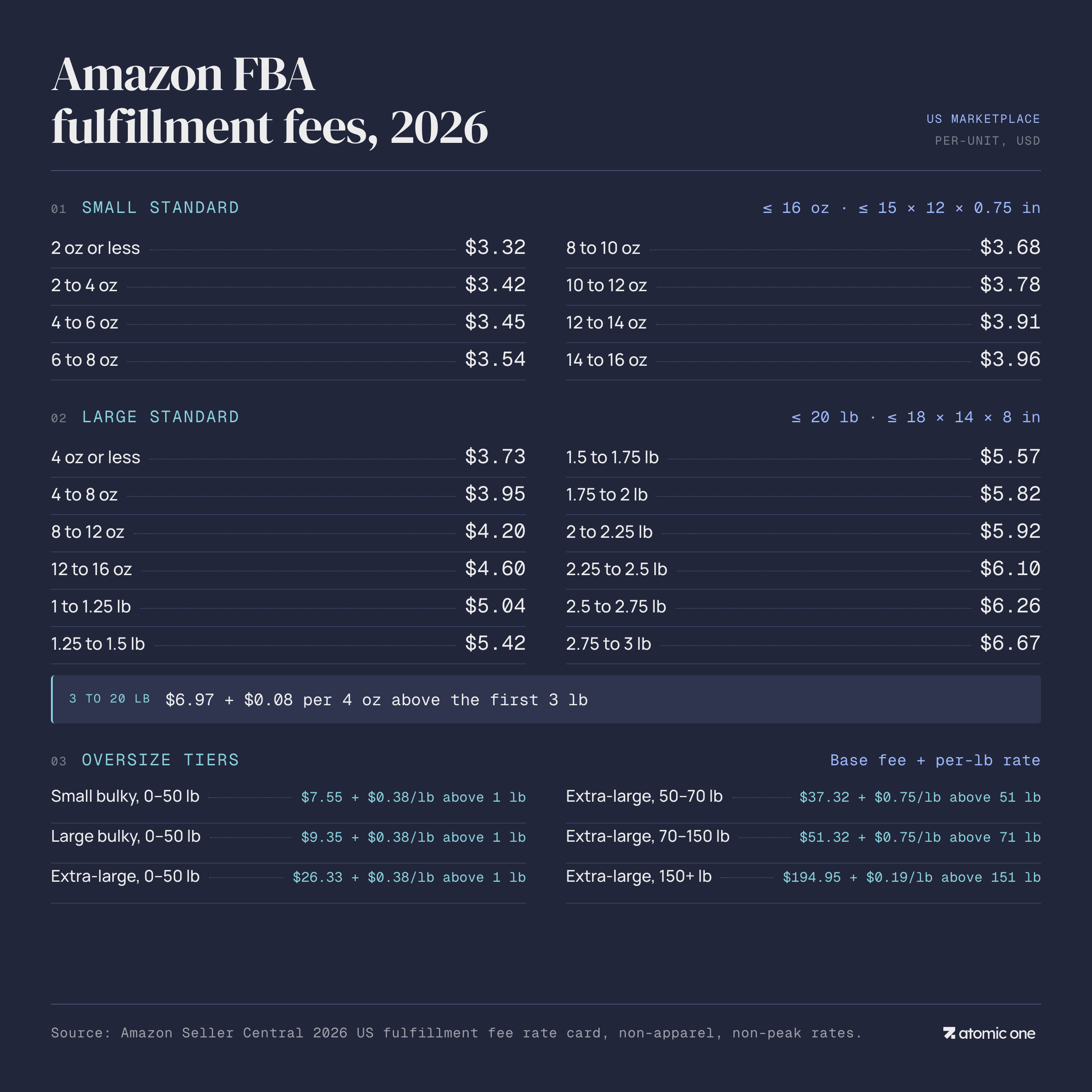
Source: Amazon Seller Central 2026 US fulfillment fee rate card, non-apparel, non-peak rates.
What the Data Revealed
This is not a hypothetical scenario.
A seller account we work with manufactured a storage product that consistently sat within a higher Amazon fulfillment fee tier because of its packaging dimensions.
Following a packaging redesign, the product qualified for a lower fee tier while continuing to meet its operational requirements.
The result was immediate:
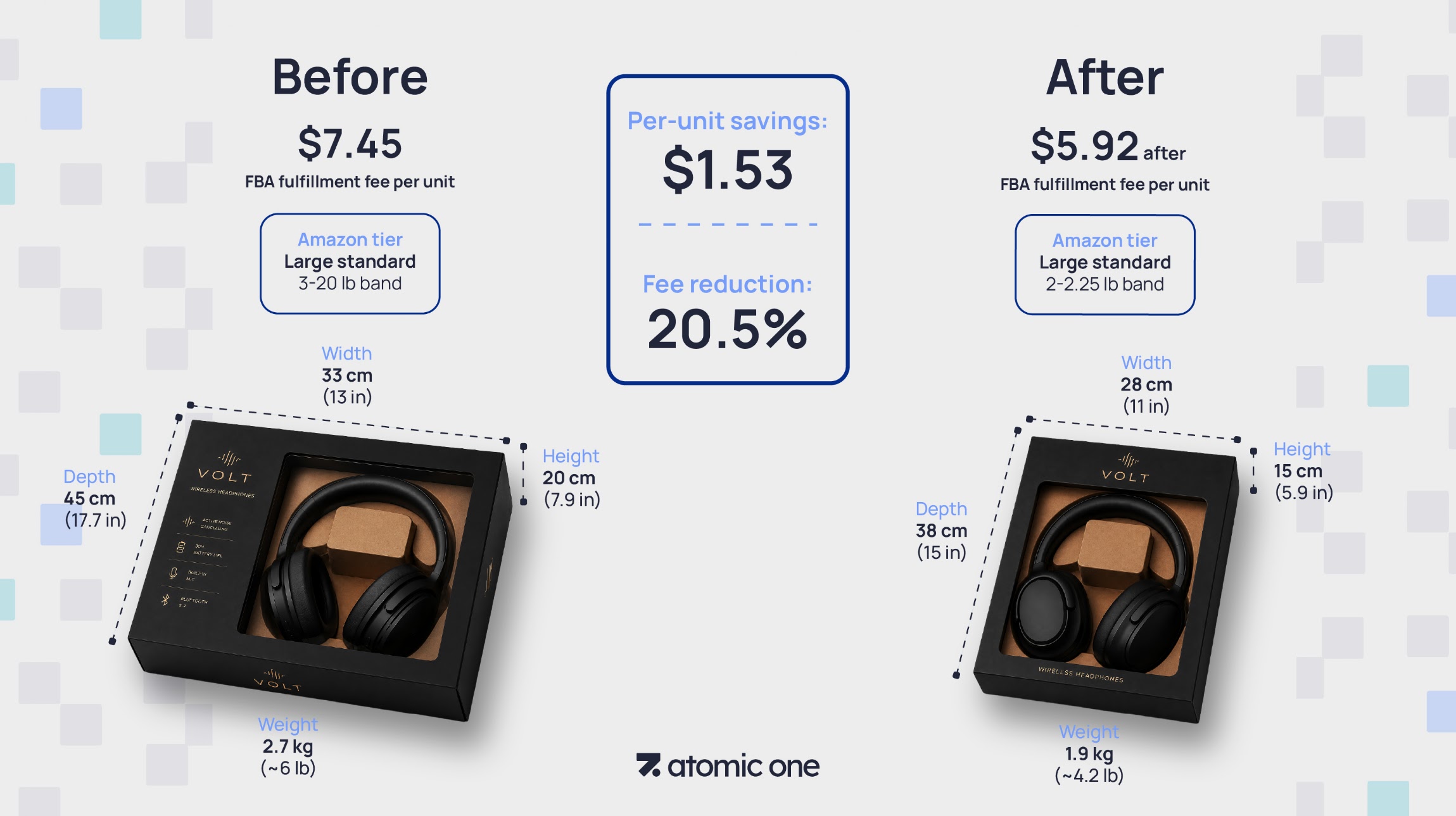
Figures from a real seller account we work with. Packaging changes that lower a fee tier do not always come free; some involve a trade-off in cost or material quality.
Here’s the breakpoint that made the difference. The product moved from Amazon’s 3-to-20-lb Large Standard catch-all rate into the narrower 2-to-2.25-lb band, each with its own fixed fee:
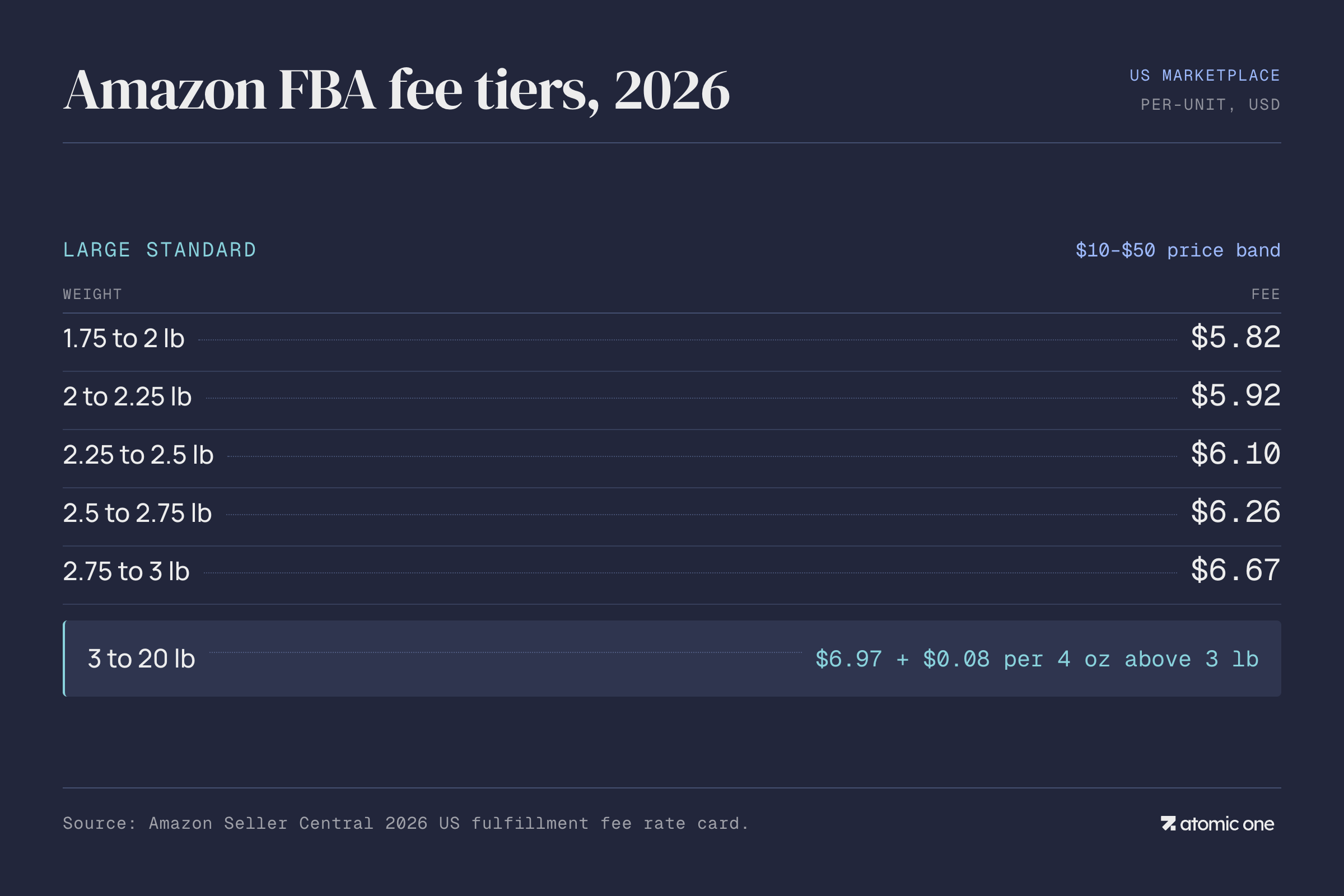
Nothing about the marketplace changed. Amazon’s fee schedule remained exactly the same.
The improvement came from understanding where the product sat relative to the fee tier break-point and redesigning the packaging accordingly.
That single operational decision reduced fulfillment costs on every unit sold.
Why These Opportunities Are Often Missed
Most Amazon businesses already have access to the information required to identify fee tier opportunities. The challenge is that the information exists in different places.
The current fulfillment fee sits in Seller Central. The product dimensions live in packaging specifications. Supplier tolerances sit elsewhere again. Amazon’s fee schedule is another document entirely.
Understanding whether a product is close to crossing a fee threshold requires looking at all of those sources together. In many businesses, no one does.
Operations teams manage suppliers. Procurement focuses on manufacturing. Marketplace teams monitor performance. Packaging decisions happen earlier in the product lifecycle, while fulfillment costs become visible later.
Each function has part of the picture, but not the complete context.
This is not a discipline problem. It is a structural one.
Packaging Is More Than the Box
Reducing packaging dimensions is only one way to improve profitability.
Working with another client account, the opportunity came from the product itself.
By reducing the fabric weight of the product, the team lowered manufacturing costs while also producing a lighter, more compact package. That change created two operational benefits simultaneously: lower material costs and qualification for a lower Amazon fulfillment fee tier.
The result was not simply cheaper packaging. It was a redesign that improved profitability across multiple parts of the business.
These opportunities demonstrate an important principle. Packaging optimization is often product optimization.
Not Every Fee Tier Improvement Is Free
Lower fulfillment costs should never come at the expense of a poor customer experience.
Some fee tier improvements involve genuine trade-offs.
A different material may reduce manufacturing costs but affect product perception. A smaller package may require a packaging redesign that introduces additional engineering work.
Some opportunities are worth pursuing. Others are not.
The objective is not to reach a lower fee tier at any cost. It is to understand the trade-offs clearly and make informed operational decisions.
Profit is the result of control, not compromise.
A Five-Minute Self-Audit
Most sellers can perform an initial review of their own catalogue without changing anything.
Choose your five highest-volume SKUs and compare three pieces of information:
- Your current Amazon FBA fulfillment fee
- Your package dimensions and shipping weight
- The current Amazon FBA fee tier breakpoints
Ask a simple question:
Is this product sitting just above a fee tier threshold?
If the answer is yes, there may be an opportunity worth investigating. Not every product will qualify, but the products that do can generate recurring savings on every future order.
Small operational improvements compound over time.
Why Continuous Monitoring Matters
The original process for identifying these opportunities was entirely manual.
It followed a documented internal procedure that required reviewing fee schedules, packaging specifications, supplier tolerances, and operational data together.
Today, that same discipline has been incorporated into Fiona, Atomic One’s Amazon Fees Diagnostics Agent.
Rather than periodically reviewing fulfillment costs, Fiona continuously audits marketplace expenses and identifies opportunities for package and packaging optimization that could reduce Amazon FBA fees.
The important distinction is not automation for its own sake. It is consistency.
No conventional team has someone continuously comparing Amazon’s fee schedule with packaging specifications and supplier tolerances at the same time. That is precisely the type of operational analysis Fiona is designed to perform.

Continue the Analysis
This article covered one verified example of how packaging decisions influenced Amazon profitability. It is not an isolated case.
Similar opportunities have appeared across multiple client accounts, each involving small operational adjustments that changed how products interacted with Amazon’s fulfillment fee structure.
The common pattern is not the product. It is the process.
If you’re managing your own Amazon operation, review your five highest-volume SKUs against the current Amazon FBA fee tier breakpoints this week. A small difference in packaging could be creating a recurring cost that has gone unnoticed.
We publish real operational breakdowns like this in our newsletter: actual accounts, real numbers, and the trade-offs behind the decisions. Subscribe below to get the next one.