

Adding more SKUs feels like growth.
A new color reaches another customer. A larger pack size increases average order value. Another variation captures another search term. Over time, the catalog expands, and each addition appears to create another opportunity to sell.
Just as often, however, each additional SKU introduces another inventory forecast, another purchasing decision, and another product that must justify the space it occupies.
The result isn’t always more revenue. Sometimes it’s more complexity. This is one of the most common structural problems in growing Amazon businesses.
Sellers continue adding SKUs and variants because each decision makes sense in isolation. Viewed together, the catalog becomes increasingly difficult to forecast, manage, and optimize.
This guide walks through a practical SKU audit you can perform on your own catalog to identify which products are creating value, and which may simply be creating work.
What Is a SKU, and Why Does It Matter?
A SKU (Stock Keeping Unit) is your own identifier for a specific version of a product.
If you sell a T-shirt in three colors and four sizes, you are no longer managing one product. You’re managing twelve SKUs. Each one has its own inventory, sales history, and operational overhead.
As a catalog grows, those individual decisions compound.
This is different from an ASIN, which is Amazon’s identifier for a product listing. A parent ASIN sits above a set of child ASINs, one for each variation, such as a color or size. Each child ASIN carries its own SKU, your internal identifier for that specific variation. Amazon assigns a default SKU automatically, but many sellers rename it to something more legible for their own inventory management, which is why the SKU name and the ASIN are not the same thing.
For operational planning, it’s the SKU that matters.
When More Choice Creates Less Profit
Many sellers assume that more variants naturally lead to more sales. The reality is more nuanced.
Across the accounts we manage, one of the most common mistakes is introducing new variations that compete with existing products instead of adding meaningful customer value.
A new color at the same price point, for example, often increases operational complexity without significantly increasing revenue. By contrast, a larger bundle or premium version may justify a higher selling price while increasing average order value.
The distinction is important.
A successful variation expands customer choice. An unsuccessful variation simply divides demand that already existed.
The strongest catalogs tend to follow a simple pattern: one clear hero SKU supported by a small number of complementary variations. Rather than competing with the hero product, secondary variants create an upsell path or satisfy a distinct customer need.
Adding another SKU should solve a customer problem, not create an operational one.
The Early Warning Signs
SKU proliferation rarely announces itself. Instead, it appears through a series of small operational signals that are easy to overlook when viewed independently.
One of the earliest indicators is a widening performance gap between your hero SKU and the rest of the catalog.
Inventory often tells a similar story.
Slow-moving variants accumulate stock, days of supply increase, and storage costs begin to rise. Promotions fail to generate meaningful sales despite repeated price reductions, suggesting the issue isn’t visibility but demand itself.
Advertising can reveal another pattern.
Running separate campaigns for similar variations frequently creates internal competition rather than incremental growth.
None of these signals, on their own, necessarily justify removing a SKU. Together, they suggest the catalog deserves closer examination.
A Practical 7-Step SKU Audit
The purpose of an audit isn’t to reduce your catalog as much as possible. It’s to understand whether every SKU earns its place.
Step 1: Start with the Market
Before reviewing your own performance, examine the competitive landscape.
How many variations do the leading competitors offer? Are those variations based on meaningful customer differences such as size, quantity, color, or style?
Amazon has become increasingly strict about variation policies. Variants should represent genuine product differences rather than attempts to capture additional shelf space.
If successful competitors offer two carefully positioned variations while your listing contains twelve, it’s worth asking whether every SKU still serves a purpose.
Step 2: Identify Your Hero SKU
Every product family has a lead performer.
Identify the SKU responsible for the majority of sales, profit, and customer demand.
Then compare the remaining variants against it.
Not every low-volume SKU is a problem. Some exist to serve niche demand or provide an effective upsell path. The important question is whether each variation contributes something the catalog would lose if it disappeared.
That requires looking beyond sales volume alone.
Step 3: Measure Profit, Not Just Sales
A SKU that generates sales isn’t automatically creating value.
Review each variant’s contribution to profit rather than revenue alone. Compare sales volume alongside advertising spend, Cost of Goods Sold (COGS), storage costs, and inventory carrying costs.
It’s common to find variations that continue to sell but contribute very little profit once operational costs are considered.
A profitable catalog isn’t built by keeping every SKU that sells. It’s built by understanding which SKUs meaningfully contribute to the business.
Step 4: Review Inventory Health
Next, examine how efficiently each SKU moves through your inventory.
Look for slow sell-through rates, high Days of Supply (DOS), or inventory approaching long-term storage fee thresholds. These are often the earliest operational indicators that demand isn’t matching the stock you’re holding.
Forecasting also becomes significantly more difficult as SKU counts grow.
Every additional variant introduces another demand pattern to predict, another replenishment decision to make, and another opportunity for forecasting error.
Step 5: Look for Internal Competition
Not every variation expands demand. Sometimes it simply redistributes it.
This is particularly common when multiple variants target the same customer with little meaningful difference between them.
Customer attention becomes fragmented, advertising data becomes harder to interpret, and optimization decisions become less reliable.
Review whether each variation serves a distinct purpose.
Step 6: Decide Whether Each SKU Adds Value
There is no universal rule for how many SKUs a product should have.
The right answer depends on customer demand, competitive positioning, manufacturing complexity, and cash flow.
Simply introducing another color or a near-identical version at the same price rarely delivers the same outcome.
Step 7: Test Before You Remove
Some variations perform poorly because they’re poorly positioned, while others create genuine value.
Higher-value bundles and larger pack sizes, for example, can complement a hero product by increasing Average Order Value (AOV) rather than competing with it.
The objective isn’t to build a larger catalog. It’s to build the most efficient one.
Download the SKU Audit Workbook
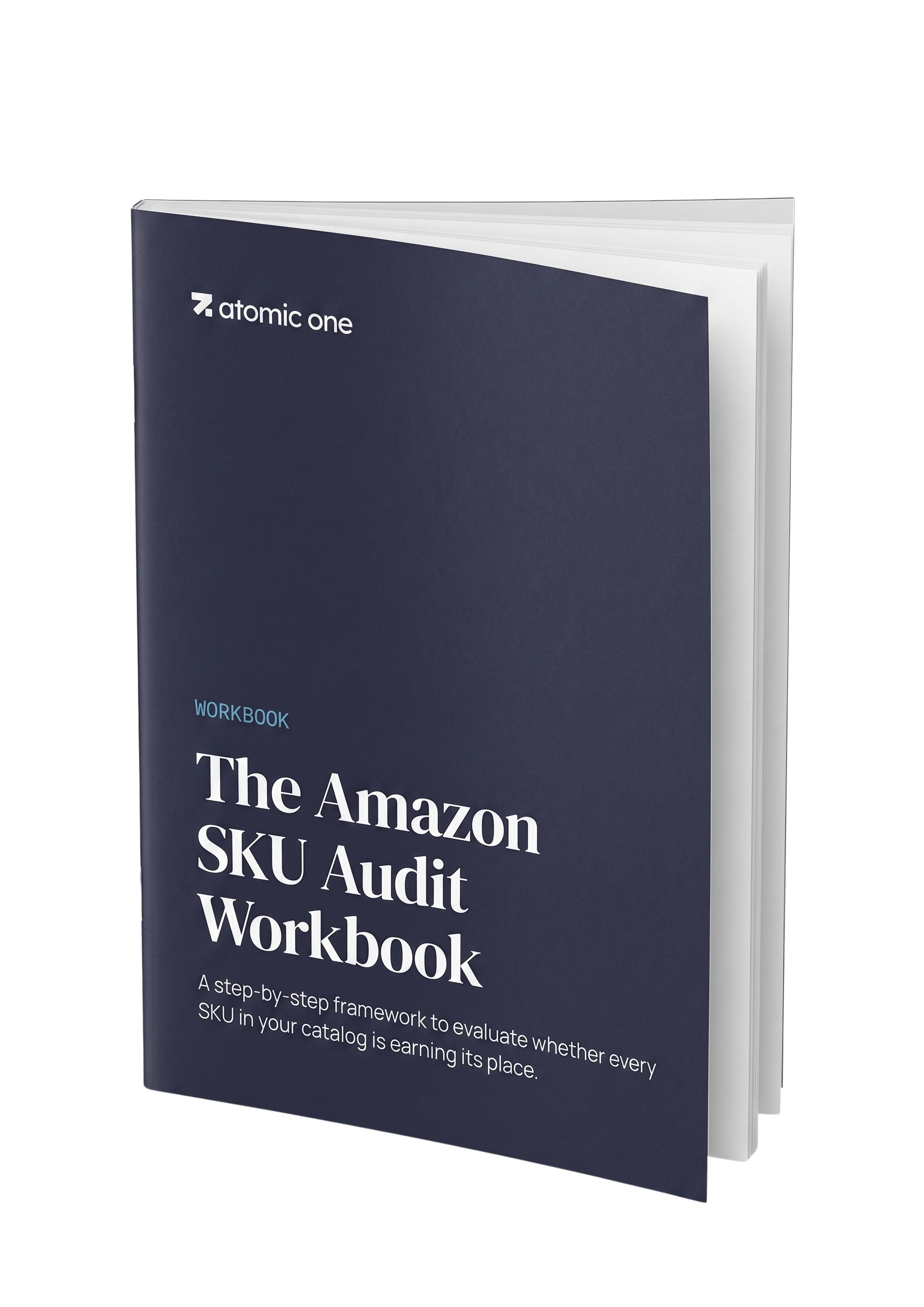
This article covers the core structure of a SKU audit. For a more accurate audit, one that walks through your own catalog data step by step, download the SKU Audit Workbook.
It includes space to record your hero SKU, profit contribution by variant, inventory health signals, and a clear decision on each SKU: keep, consolidate, or remove.
Why Spreadsheet Reviews Miss the Problem
Most catalog reviews happen periodically. Sales, inventory, and advertising are analyzed separately, leaving the bigger picture hidden.
The issue isn’t review frequency. It’s that no conventional workflow evaluates how each SKU affects the wider operation.
From Periodic Reviews to Continuous Coordination
The most effective SKU audits aren’t one-off exercises. They become part of an ongoing operational process.
At Atomic One, this coordination is supported by our AI Deals Execution Agent, Dave, who exists to improve inventory movement and support healthier forecasting decisions.
He analyzes inventory positions alongside market signals to recommend and execute promotional strategies.
Rather than treating promotions as isolated marketing campaigns, they become part of a broader operational system that considers how inventory, demand, and catalog performance interact.

Audit Your Catalog Before You Add Another SKU
Growth isn’t measured by how many products you sell. It’s measured by how effectively each product contributes to the business.
Before launching another variation, review the catalog you already have. Identify your hero SKUs. Measure true profitability, not just sales.
If you’d like a deeper look at how your catalog, inventory planning, and forecasting work together, talk to the Atomic One team.
We’ll walk through the operational signals that influence inventory efficiency and show how continuous coordination can uncover opportunities that periodic spreadsheet reviews often miss.