
Six weeks after launch, Mary has a problem.
Her new Amazon listing is generating traffic. The product is competitive. The detail page is doing its job. However, the listing has very few reviews.
Shoppers arrive, compare it with established competitors, and leave. The team sees the obvious problem: reviews.
They start looking for ways to accelerate them, but that’s where the real problem begins.
The early-review catch-22 is not solved by finding the fastest possible way to generate reviews. It’s solved by understanding which channels are compliant, which tactics only appear safe, and what reviews can actually do for a listing once they begin accumulating.
Reviews unlock conversion. They don’t create it.
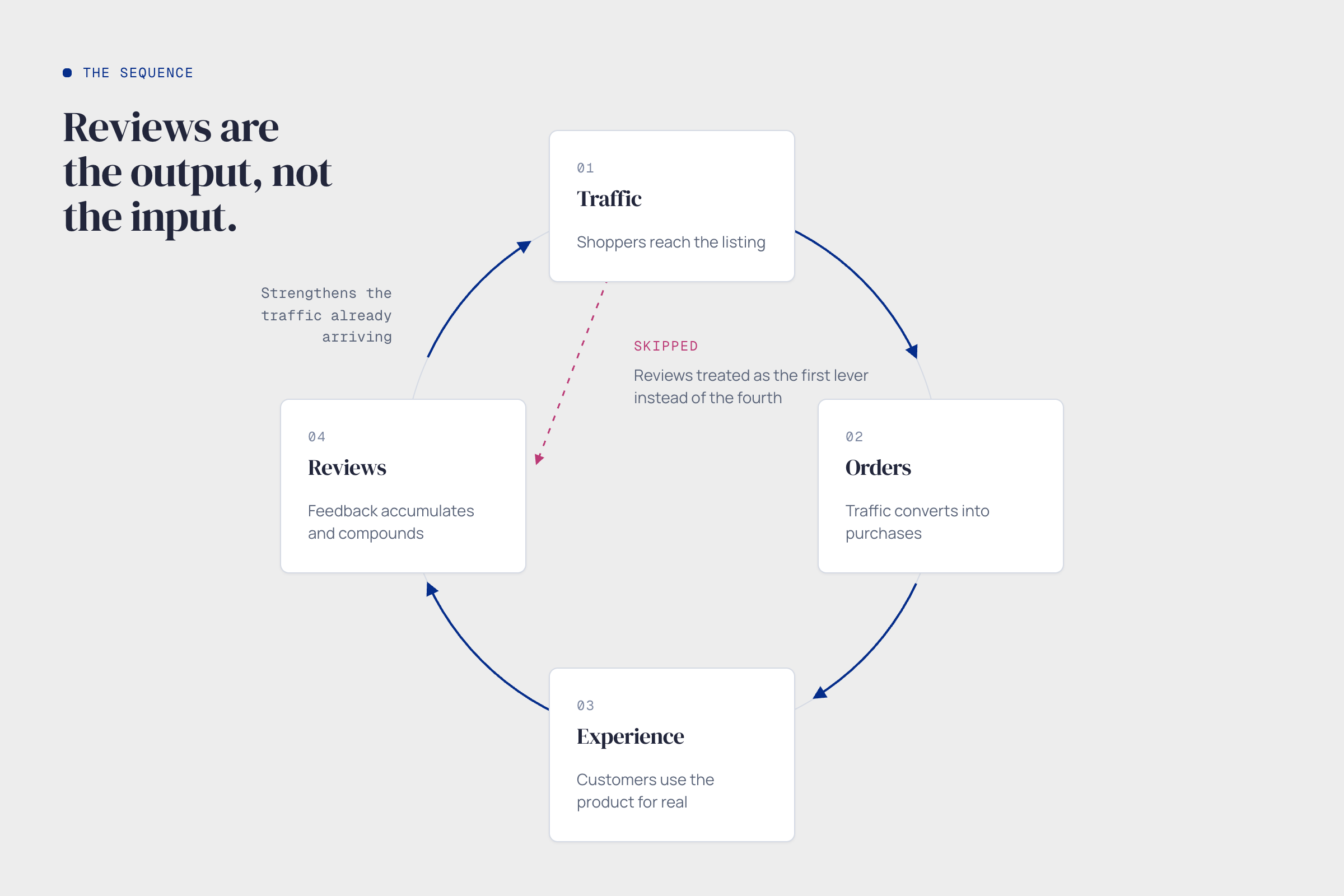
The Review Loop is a Sequencing Problem
A new listing has to establish several things at once:
- Traffic to generate orders
- Orders to generate legitimate customer experiences
- Legitimate customer experiences to generate reviews
- Reviews to strengthen conversion, making the traffic already reaching the listing more productive
That creates a feedback loop. The mistake is treating reviews as the first lever.
If the product, positioning, images, copy, price, or customer experience are weak, adding reviews does not solve the underlying problem. It simply gives more shoppers evidence to evaluate.
Amazon is also explicit about the boundaries around review manipulation. Sellers cannot offer incentives for reviews, ask customers to change reviews, or use personal relationships to generate reviews. Amazon also warns against directing negative feedback away from its review system.
So, the question isn’t “how do we get reviews as quickly as possible?”, it’s “which compliant mechanisms can generate authentic reviews while the rest of the listing is being optimized?”
That distinction matters.
The First Bad Review
Back to Mary’s launch.
The listing gets its first handful of reviews. One is positive. Another is neutral. Then a customer leaves a low rating. The team panics.
Someone suggests contacting the customer directly. Someone else suggests offering a refund in exchange for changing the review. Another person proposes adding an insert to future orders:
“If you love the product, please leave us five stars. If there is a problem, contact us first.”
None of these solves the problem. The correct response is less dramatic. Treat the review as product data.
What did the customer dislike? Was the complaint about quality, packaging, expectations, sizing, instructions, or something else?
If the issue reveals a genuine product or listing problem, fix the cause.
A negative review is not necessarily evidence that the launch has failed. On a young listing, however, a small number of reviews can make individual ratings disproportionately visible. The solution is not to suppress the negative signal. It is to keep building a legitimate body of customer feedback.
That is the beginning of breaking the loop.
What is Actually Compliant?
There is a surprisingly small set of mechanisms sellers need to understand.
1. Use Amazon’s “Request a Review” function
The simplest approach is also one of the most easily overlooked.
Amazon provides a built-in “Request a Review” function in Seller Central. Sellers can use it for individual orders rather than creating their own review-request language or contacting buyers through alternative channels.
Amazon has specifically recommended using this feature rather than requesting reviews through Buyer-Seller Messaging or email.
The important point is the neutrality of the request.
You’re asking for a review. You’re not asking for a positive review. That difference is fundamental.
Approved third-party tools can also automate compliant workflows when they use Amazon’s permitted systems and APIs. The objective should be operational consistency, not a more aggressive interpretation of the rules.
2. Consider “Amazon Vine” – An Overview
“Amazon Vine” is Amazon’s official program that gives eligible products to selected “Vine Voices,” who then provide reviews based on their experience with the product. Amazon describes Vine as a way to help generate high-quality reviews and give shoppers more information when evaluating products.
Vine can be useful for a new listing because it creates a structured route to early product feedback, but it is not a guarantee of positive sentiment. That is the point sellers sometimes miss.
Vine reviewers are not there to validate a launch plan. They are there to evaluate the product. If the product has a flaw, confusing instructions, poor packaging, or a mismatch between the listing promise and the customer experience, Vine can expose it quickly.
That makes product readiness more important, not less. Before enrolling, ask a straightforward question: “If a knowledgeable customer scrutinized this product today, would we be comfortable with the answer?”
If not, reviews are not the first problem to solve.
What Sellers Commonly Mistake for Safe
The dangerous tactics are often the ones that sound reasonable in isolation.
“I’ll ask friends and family.”
Don’t.
Amazon prohibits sellers from using family members, employees, or other personal relationships to generate reviews. The fact that someone genuinely purchased or used the product does not make the relationship irrelevant to Amazon’s review policies.
“I’ll put a review request in the box.”
The insert itself is not the issue. The language and intent are.
An insert that pushes customers toward a positive review, offers an incentive, or attempts to divert unhappy customers away from Amazon can create a policy problem. Amazon specifically identifies requests for positive reviews and review-linked incentives in packaging as prohibited.
“I’ll only contact unhappy customers.”
This is another version of review manipulation.
Customer service should resolve customer problems. It should not become a filtering mechanism that sends satisfied customers toward Amazon and dissatisfied customers somewhere else.
The distinction is simple:
Resolve the customer problem. Do not engineer the review outcome.
What Happens Once Reviews Start Accumulating?
This is where the strategy changes.
Reviews reduce uncertainty, but they work alongside the rest of the conversion system.
A shopper is still evaluating the main image, title, price, delivery promise, product quality, and perceived value.
A listing with more reviews but weak fundamentals can still underperform. That is why the early launch period should be treated as a diagnostic phase.
Watch how shoppers behave. Are they clicking but not converting? Look at the listing.
Are they converting but generating complaints about a specific feature? Look at the product.
Are reviews consistently mentioning the same objection? Look for the underlying cause.
Are reviews accumulating but conversion remaining weak? Reviews may not be the constraint.
This is the critical shift: stop treating the review count as the entire health metric for the listing.
Back to Mary
Mary’s team eventually stopped treating the review count as the only problem.
They used Amazon’s permitted review-request process consistently and evaluated Vine as part of the launch strategy. When negative feedback appeared, they looked at what it was actually telling them rather than trying to influence the outcome.
Some of the feedback pointed to expectations the listing had not set clearly enough. Other comments exposed product issues that needed attention.
The review count continued to build, but that was no longer the team’s only measure of progress.
They were watching whether shoppers were converting, what customers were saying after purchase, and whether the listing was becoming more convincing as genuine feedback accumulated.
The loop was not broken by finding a better way to manufacture reviews.
It was broken by putting each lever in the right sequence.
The Framework
For a new SKU, the sequence is straightforward:
The objective is to build a listing where authentic reviews reinforce an already credible product and a conversion-ready page.
That is how the review loop actually breaks. Not through a shortcut. Through sequencing.

Reviews compound the work. Chloe makes sure there’s something worth compounding.